by Mike Clarke
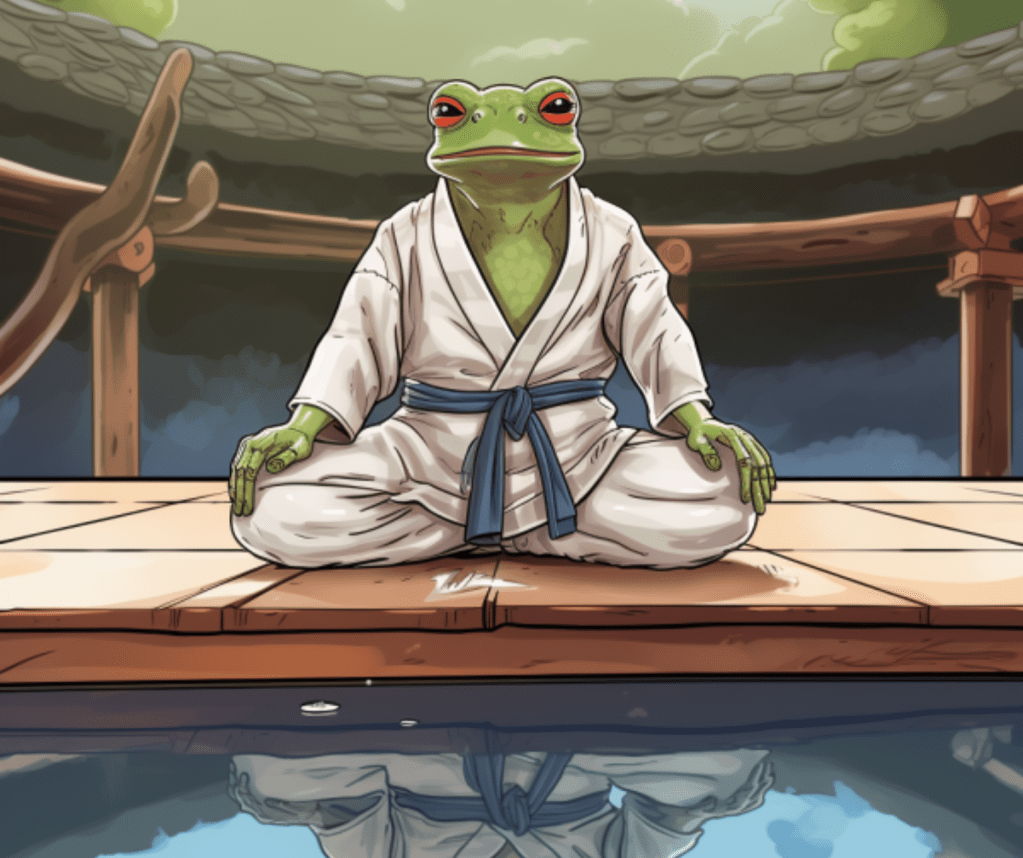
I’d like to discuss karate’s ‘bigger picture’. That karate is larger than any one group, style, teacher, or nationality. I want to open up the box of knowledge and information marked “Suitable for ‘my’ style only” and put forward the crazy idea that good karate is good karate regardless of the branding and tribal thinking the art has suffered from since going global. I also want to balance that idea by looking at ‘bad karate’ and why those who practice it don’t need me or anyone else to highlight just how bad they really are. An old Chinese proverb points to something so obvious its message is often lost on those who come across it,
“The frog at the bottom of the well will never know the enormity of the sky.”
So here’s the thing, we are all in danger of being a frog. If you sit at the bottom of your well (style, club, association) safe in the belief that you are looking up at the entire sky your chances of understanding the enormity of karate (or any martial art) is limited, actually it is impossible. When you draw all your knowledge and information from a single source (teacher, association, style), then you are merely copying the actions of another frog sitting at the bottom of a different well. Because no single source of information, however famous or well promoted, will help you find what you’ve been telling yourself you’re searching for.
But wait a minute. If you don’t stick to a single school of karate, teacher, or organisation, then learning karate would become chaotic, right? It would stop making sense, wouldn’t it? HELLO! Just look around you. Most of today’s karate makes no sense at all! Sport and business masquerading as budo, self-defence being taught by people who have never had a serious fight in their life, and money and commerce taking the place of morals and personal growth. If that doesn’t look like nonsense to you then turn the page now and read the next article,because nothing I’m talking about here will mean a thing. But before I go any further, I want to address something we all have to guard against…the duality of thought. Its a problem for people when confronted by it, few can say with any degree of honesty that we are impervious to it.
By duality of thought, I mean the ability to believe you are doing one thing yet act contrary to that belief and not see a problem living with the difference. In learned circles,the notion of ‘Cognitive Dissonance’ goes someway to explaining the forces at play here.The discomfort felt by an inability to align your thoughts with your actions causes you to suspend your normal clarity of thought and accommodate your good thought and bad action as being equally okay.
Here are a few classic examples of what I mean…
Karate-do is about polishing your spirit.
Well, it might be, but if that’s what you believe, then why have you turned it into a job? If the aim of your karate is to “polish your spirit”, how did you come to be so dependent on your students for your income? How come you spend very little time training(polishing) compared to teaching (pampering to your ego)? If you don’t have clear answers to questions like these then it’s safe to say your relationship with your martial art is dualistic.
If your home life and personal relationships are problematic, how exactly is climbing into your do-gi and wrapping a belt around your hips helping you with that? If your karate comes on and off like your shoes, which part of your training is making your life a better experience? If you hate your job, why haven’t you found ways to solve that situation from lessons learnt during training? You can’t focus inward on yourself (polish your spirit) if most of your involvement with karate is spent focussing outward on others. Any martial practice that uses the suffix ‘do’ points to a way of being in the world.However, if you suffer from dualistic thinking, then it’s hard to know where you are, other than lost. Here’s another example….
Karate is an art of self-defence
Well again, it might be, but not for you. Not if you’re unable to defend yourself from your own ego or the adversities life brings your way. If all you have are a few kicks and punches and a couple of remembered kata,then, in reality, you don’t have much of a defense at all, regardless of what you believe. The dream of being able to defeat the bad guy in the street or the intruder in your home is a powerful one. No one wants to be taken advantage of that way. But the vast majority of people training in the martial arts, especially those deemed ‘traditional’, will never face these situations, and it’s exactly those odds that allow the martial arts to be sold as a means of physical self-protection… because the chances are, you’ll never find out that your training was useless.
As to the stories of those who have fought the good fight and won. In 50 years of training I’ve heard the story many times but have yet to meet a single person who has faced such a situation and walked away unscathed due to their superior fighting abilities. In truth, if you don’t have the mentality to fight, knowing a few ‘moves’ won’t help you. As well as the‘fight or flight’ most are familiar with, there are also the ‘freeze and appease’ responses.
When faced with a surprise attack or potentially overwhelming situation, people with no place to run and an unwillingness to fight (fight or flight) will either freeze or attempt to appease their adversary. Either option denies you an opportunity to take the initiative and solve the situation to your advantage. I doubt the majority of instructors teaching ‘practical self-defence’ have trained in, let alone mastered, the mindset required to handle raw and unforgiving violence. If you advertise self-defence as a part of your training, I hope you’re honest enough with your customers to tell them everything your teaching them is theoretical.
In nature, few things happen overnight. So, the seismic shift in thinking over the past sixty or so years has, by steady increments, changed how today’s karateka think about their training. No longer the brutally effective fighting system it once was, or the severe self-effacing practice it turned into when the notion of ‘jitsu’ was replaced by ‘do’. Karate today is not by any measure what it used to be. That said, the comparison between the past and the present would have little meaning if it were not for the current crop of karate instructors relying so heavily on the past to validate their ‘modern’ approach to training.
If your involvement with karate is dependent on teaching others then from my perspective you’re lost. Regardless of your (good)intentions, when your focus shifted away from your own personal cultivation and onto teaching others, your notion of ‘do’ and ‘self-defence’ was severely compromised by your decision. The recent Covid-19 situation highlighted this mistake to a great many martial arts instructors around the world,impacting their lives
(through loss of income) in a far more significant way than was necessary. If only they had understood how to defend themselves financially as well as physically. Although I doubt the idea of teaching karate as a job will die out completely, the recent lock-down may have provided some ‘instructors’ with an opportunity to spot their error in judgment and recalibrate their relationship with karate. In truth, that would take a willingness to be open to personal introspection and have the courage to act. Sadly, not so many instructors teaching karate these days have either in sufficient quantity to be of any use.
The final example of dualistic thinking I’ll provide is found in the idea of ‘Family’. You’ll hear this word used a lot in karate circles. It’s a nice, wholesome thought, but it’s also a deep-seated illusion in the mind of many modern karateka. I highlighted its origins in my previous article (WAMA #1) so please refer to that edition if you’d like to know more.
Our dojo/group/world-wide association is like a family
Except that’s not really true, is it? Parents help their offspring when they’re facing hardship. They provide support, both emotional and financial. The myth of the‘karate family’ was well and truly tested during the Covid-19 pandemic. I’m unaware of any ‘professional’ instructor, group, or organisation that offered more than a few classes online to tide folk over the lock-downs. With all the money that flows into these ‘families’ year after year, if ever there was a time for that flow to go the other way, it was during the pandemic.
Students and their families faced real hardship, loss of income, and, in some cases the loss of their homes. So where was the parent then? How many associations offered financial assistance to their members? How many so called ‘sensei’ gave back to their students in a meaningful way. Not as many as those who reminded their followers constantly to stay ‘loyal’ and to get back to training as soon as they could. And before you ask, all the students at my dojo were offered, no strings attached, no payback, financial assistance. Only one had to make use of it.The two-way street of loyalty is in practice,more likely to be a one-way road leading to the best interests of the instructor and the group. Clearly visible from a distance, the notion of family for a great many training in karate these days is more closely aligned to the activities of a cult than a clan.
Taking responsibility
When you’re a frog at the bottom of the well, your chances of comprehending the enormity of the sky is non-existent. You simply can’t know what you don’t know. When you’re a karateka with a narrow view of karate, your chances of grasping the enormity of the art are restricted in similar fashion. The notion of ‘Shoshin’, the ‘Beginner’s mind’, or more appropriately ones ‘First mind’, is key to escaping the claustrophobic confines of your situation at the bottom of the well. Shoshin reflects an openness, curiosity, and daring. An inquiring mind hungry to understand new things and expand its horizons. To go deeper and move beyond the superficial. Now, contrast that with the narrow message coming from so many karate instructors today who push the idea that above all else you have to be a loyal follower. When you do that you begin to understand how dualistic thinking stifles potential and transforms so many enthusiastic karateka into nothing more than frogs sitting at the bottom of their own myopic well.





Leave a Reply