Finding her way back to Jiujitsu after stepping off the mat for a decade…
by Sheryl Sumugat
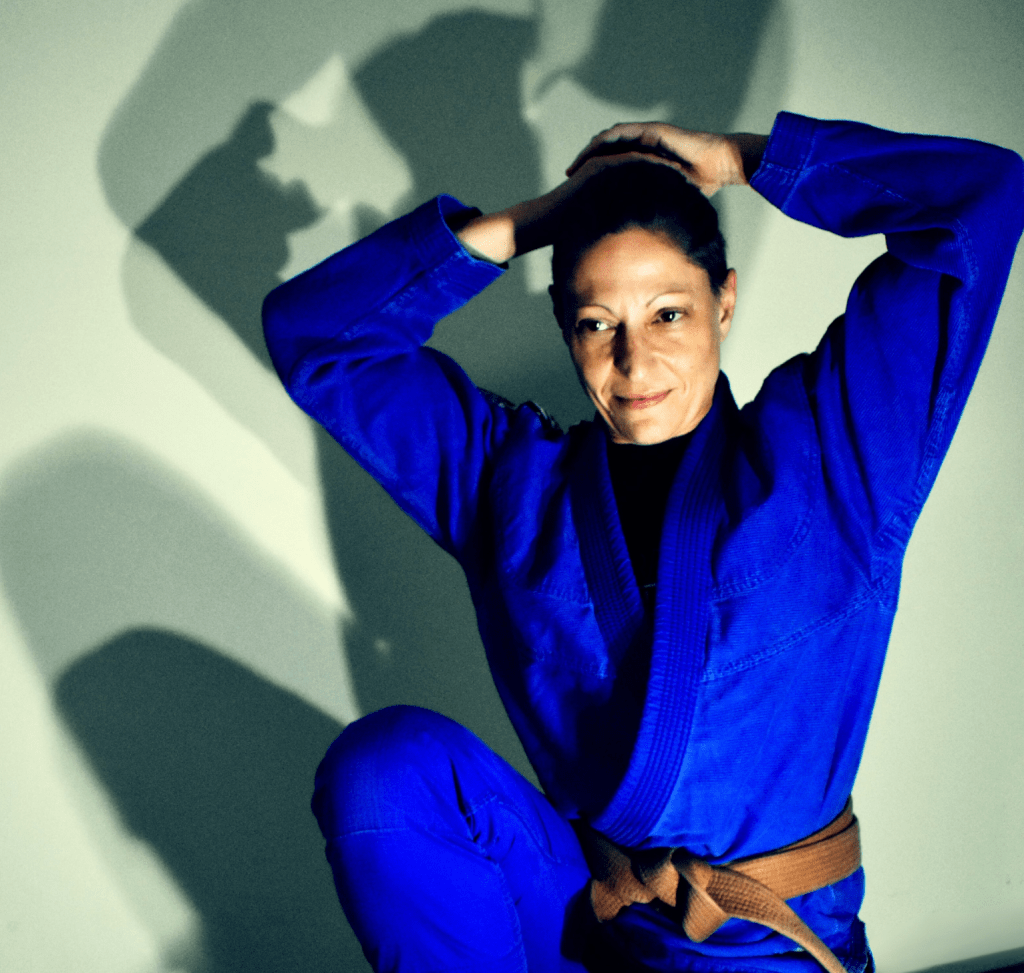
Christianne Blenkin is the first and currently, the only female brown belt of Toowoomba’s Behan Jiujitsu gym. Like a lot of women today, she wears different hats: doting wife, mum of two, yogi, BJJ kids’ coach, and an actively training and competing Jiujiteira. Just this year, she’s already competed twice, and took three gold medals, one silver, and two overall trophies for women’s gi and no gi.
I invited her for an interview to chat about her Jiujitsu journey. As a female white belt who trains at the same gym as her, her persistence and tenacity are a source of inspiration. I was compelled to know more of her story when I learned that she has been training for 20 years, but with a 10-year break. The story about what made her leave and what pushed her to come back is something I believe women in martial arts could learn a lot from.
Q: How did you discover Jiujitsu and what made you give it a go? It was when I was in my 20’s and I was kind of a little bit lost. I used to train at the gym, but I used to watch the Jiujitsu class. It was a big gym, and the Jiujitsu class was the last class of the day. I never actually stayed till the end of Jiujitsu but what I used to watch was the warm-ups, so I would see them doing forward rolls and backward rolls, cartwheels, and I was a gymnast, so I was like “Oh this looks fun. I would be good at it”. The coach kept saying, “You should come and give it a try.” So, I gave it a try.
I come from a background of alcohol and drug addiction, so I used Jiujitsu as my new thing. All my focus and energy went into Jiujitsu so that my life didn’t go into addiction, spiraling downwards. So, I entered it with such ferocity. I started competing immediately and not just locally. I went internationally, nationally, and just pushed and pushed and pushed until my body was broken. And then they said, you might not have kids if you don’t stop.
Life was hard and painful. Jiujitsu was a thing that I would use each day to pick myself up.
Q: So why did you stop?
I pushed myself so hard that I lost my love for it. I had retired and then I just decided to go to Pans Pacific just to see how I went in 2010. When I got down there, I got paired with the brown and the black belt. I was a purple belt, and I won the division. And then, I had people interested in sending me to the Worlds. So, I went to the Worlds and I was teaching females at the time as well. I took one of my students over at the Worlds. When I got there, I realized I’ve made a huge mistake. I didn’t have the fight in me anymore. Also, because I’ve been told “Oh your body’s broken.” I was told, “Don’t go down the weight division, because your body can’t handle it”, so I tried to go upper weight division, but my body wouldn’t take on the extra weight. By the time I got over there, I had fallen back into the division below and then I was fighting big monsters.
After I went to the Worlds, I never went back to Jiujitsu again.
Q: Could you tell us why?
I think I felt like that chapter was done. I pushed and pushed, and I was doing it because I was good at it, not because I loved it. And then when I got over there, I realized that if you don’t love it, then you can’t push yourself to do it. So, I came home, and I didn’t say goodbye to my coach. I just left.
Q: How did you get back to it?
Well, over the years, my husband has always encouraged it. We got together just as my Jiujitsu journey ended, but he knew me before, so he knew my Jiujitsu journey. “You should go back,” but I was like, “I’m done!” I started doing yoga to heal my body and my mind. I felt like I had a lot of stuff that I needed to process. Jiujitsu became more like an outlet for my anger. Eventually, when my son was looking for a sport, we’ve tried everything, but he just didn’t like anything, and I thought, “You know what he’s a lot like me, I bet he’d like Jiujitsu.” And I took him to a class, and he loved it. I was like, this is what he was meant to be doing because we have similar personalities. It didn’t take long. I was watching and then my body knew the movements, and my body just wanted to be on the mats. I resisted for a little while.
Q: Why did you resist?
Because it’s a confusing journey. There are so many ups and downs in your Jiujitsu journey, like in line with your life. “And I’ve just yoga’d myself into calm, and they’re like yin and yang, opposites, but perfectly aligned.”
Q: Like they complement each other.
Yes. And I believe that I’m a way better fighter now that I’ve got a yoga background. Way calmer, less ego, and more about embracing the fun and the connection, finding the safe space where you can be a mess, knowing that your teammates have your back.
Q: What were your biggest struggles and how did you overcome them?
Being a woman in sports years ago was tough. I was the only woman in the class, so finding fair fights felt like walking a fine line, either I was being patronized because they didn’t want to hurt me, or they were overly rough because they didn’t want to lose to a girl. I found it really hard. It was also difficult to gauge where I stood, especially when there were no other women to fight against.
That’s why I travelled so much, I wanted to see what I was truly capable of against other women. I had to go where the girls were. I went wherever I could find real competition. I was very competitive.
Q: What would be your advice to women like me who struggle with the motivation to train, and turning off their motherly, gentle side?
Find your people that you’re safe with. Communicate with them what you need. Advocate for yourself. Be really honest. When you’re rolling, if somebody’s done something that you don’t like, tell them—which is really scary because there’s that fear of judgement. But I feel like you will have more honest and safe rolls if you can be really, really open. Like it’s okay to say, “That was really rough”. And the best rolls I had were with the people where we check in with each other constantly.
Q: How would you define too rough in JiuJitsu?
It totally depends on where you’re head at at that moment in time, which is why it is something that you constantly need to express. What you thought was rough yesterday is totally different from what you think is rough today, depending on what’s going on with your life. So, you have to feel like these people that you’re rolling with understand that. And I totally find those people in the gym. Some people feel their feelings in the mat. So, if they come in and they have a bad day, they’re gonna tear your limbs off, because that’s the way that they could express it. You just gotta be aware of other people’s energy, and you have to be okay to say, “Not today” to people. It’s okay when you first start to have a small circle of people you feel safe with, and then, when you feel safe and ready, slowly move out of your circle. Even as a high-ranking belt, I still do that. I don’t rush into being like I should be able to roll with all these different people, because that’s what it’s all about. You’ve gotta nurture your own growth.
Q: Lastly, do you believe that a Jiujitsu gym is a place for women, and how do women affect its culture?
I absolutely think that women belong in the gym, especially as a kids coach. I think it’s really important to show the next generation that women are warriors too. Having female coaches for the kids’ class is amazing, because boys get to go, “Oh, women are strong!” and not just have that pure male presence. I think that women need support from other women in a place like that to know that they do belong. People like me are a pinnacle in seeing that your journey can continue over the years, through motherhood, through so many changes, that it can still be there, and that it can still be something you can benefit from. We kinda offer a softness, maybe, a balance. We offer the yin and the yang energy. Men would find rolling with women different. I think that will help their game, because we’re more technical. We fight differently. We bring technique.
From Issue #5 Martial Arts Magazine Australia

 Martial Arts Magazine Australia
Leave a comment