by Mike Clarke
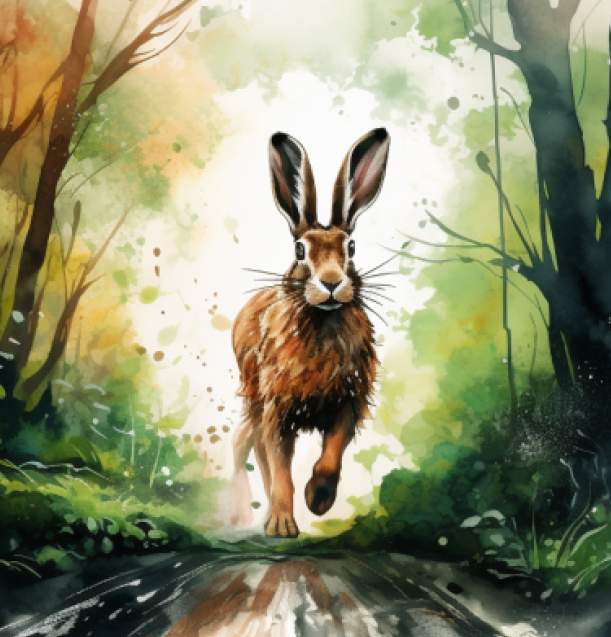
In her book, Watching the Tree, author Adeline Yen Mah, passes on an anecdote told to her by her grandfather. At the time she was a thirteen-year-old girl living in Hong Kong and thinking of running away from home to live with an aunt in Shanghai. She had left the city with her mother at the age of ten and was convinced she could return and pick up her life there again, exactly where she’d left it three years earlier. Wondering if her grandfather would lend her the fare, she asked him, and explained what she intended to do once she got to Shanghai. The reply her grandfather gave was not the one she was hoping for. He did not loan her the money, but he gave her a gift that remained with her for the rest of her life. The gift was a story about experience and about change; it was a story about a boy, a hare, and a tree…
“Once, long ago in China, a young apprentice was told by his teacher to go into the forest and catch a hare for dinner: the young man took off full of excitement. However, as he had never hunted before he had no real idea how he was going to accomplish the task his teacher had set him. Shortly after entering the forest, he spotted a hare running very quickly along a path. Suddenly it turned and ran head on into a tree. Because it had been running so fast the impact with the tree killed it instantly, all the apprentice had to do was pick it up and bring it back to his teacher. The young man’s triumph was short lived however, for even though he returned to the forest many times afterwards he was never able to bring back another hare. You see, whenever he went back to the forest, instead of looking for a hare to ‘catch’ he simply returned to the same tree, and there he sat, waiting for another hare to run in to it.”
When I first read this story, it struck me that many karateka also spend their time, metaphorically speaking ‘watching trees’ instead of acquiring skill; and perhaps this is why so many karateka remain hungry for information. So hungry, in fact that they regularly attend seminars to train with instructors who, in many cases, have simply been ‘watching a different tree’ for a longer period of time. Had the young apprentice in the story learnt to catch a hare, even by trial-and-error, he would have developed a useful skill. He would have also come to understand that nothing in life (or hunting) stays the same. He would have discovered that each hunt would have to be conducted differently depending on the season and the conditions he found in the forest. He would have realised that there are fundamental rules he needed to follow, but the actual method he used could be adjusted to the prevailing conditions of the day.
The parallels with karate are clear, if as a karateka, you keep in mind that your first visit to a dojo is to ‘study’ karate, in time you will learn a useful skill. You will come to understand that no two training sessions are ever the same. You discover each session will see you face different challenges depending on the lesson. You will also come to realise that there are fundamental rules that need to be followed but the principles of karate will allow you to adjust your technique to suit your own body and the prevailing conditions of your health once you are skilled enough to understand karate’s core principles. It is too bad that many karateka are not educated this way.
Many who are new to karate, and many who are not, are mistaken when it comes to where the ‘fighting’ is taking place; erroneously believing that karate will help them defeat someone else; well, it might, but that’s missing the point. In my book, Redemption, I traced the path to self-destruction my life was taking as an irascible teenage street fighter; and how, with a discipline first imposed by others, and later, by myself, karate training revealed a sense of purpose and the prospect of a life that up until then had evaded me. Hidden in plain sight but made visible only through the lens of sincere introspection, the ‘way’ of karate points directly to the source of human conflict: the mind. What goes on inside your mind determines, to a large extent, what happens in your world.
Beginners in karate are commonly pointed in the wrong direction, and because of that, quickly become attached to the things they first encounter, just as the apprentice became attached to the tree that killed the hare. Indeed, new karateka are often encouraged to cling to the very ideas and practices that will hinder their progress the most. For example, the focus on status, rank, and becoming a ‘champion’, diverts attention away from the real purpose of training in karate, which is to protect yourself (often from yourself). Becoming hooked on the external trappings of your training places you on a path leading you away from obtaining tenure of your karate, promoting instead, a sense of dependency on others.
When you ‘watch the tree’ in your mind, you fix yourself in a moment of time, ignoring he fact that time, like life, never stands still. You fail to appreciate that in order to grow as a human being you must learn to adapt to the changes time (and living) endlessly bring. Adaptations arise from failure, so you must learn to invest in that rather than hold your breath until you succeed in something. Many who walk away from karate once they have a ‘black belt’ and the rush of youth has ended, do so not for the reasons they provide to others, but because they have given up hope of another hare ever running in to the tree they have been doggedly watching for so long. Their failure to repeat the ‘success’ of their early years in karate becomes too much to deal with, and they simply give up the struggle. Few question if their failure to invest in their own shortcomings kept them looking for success in the wrong place.
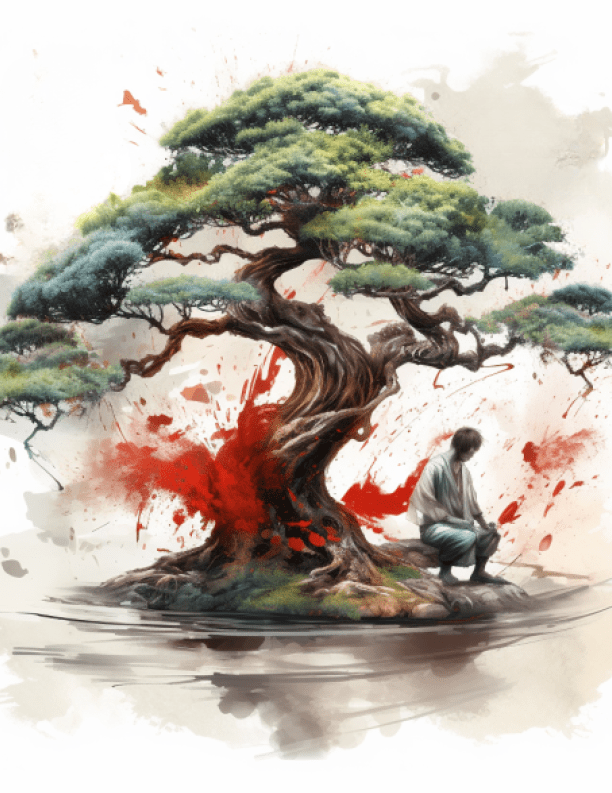
Maybe, from time to time, if you have the courage, you should ask yourself… ‘Am I a tree watcher?’ Thinking about things like this is always helpful. Did you attach yourself early on to the wrong idea of what you were doing when you began training in karate? Did you, all be it unwittingly, step on to the dojo floor for the first time and on to a path that led you away from the very things you were searching for? When sitting in mokuso, at the end of a hard training session maybe these are the kind of questions to be pondered. Focusing your effort solely on the physical techniques of karate that you enjoy or come easily to you is as much a tree watching exercise as filling your head with dreams of samurai, black belts, and becoming a karate ‘master’.
Clearly, it is not possible to move forward while standing still. So, unless you are a believer in the maxim: all will come to those who sit and wait, it is important not to focus for too long on any one aspect of your (karate) education. Understanding karate is after all a ‘feeling’ for what you do, rather than merely the accumulation of information committed to memory. Watching a tree, regardless of the length of time you do it, won’t bring you a single step closer to what you are looking for. How many karateka are learning something useful and how many are simply waiting for something to happen is a difficult question to answer. In my experience there are certainly more people training in karate than studying it, and far more ‘instructors’ masquerading as sensei than there are ‘teachers’. When I consider how many karateka training today have learnt to ‘catch a hare’, and how many have simply sat and watched a tree, the future of authentic karate doesn’t look good.
Thought and action, form and function, it’s easy to see you need all four to make progress. If the concepts underpinning karate fail to become a normal part of who you are, then you are left with the alternative, the temporary ability to move your arms and legs in in ways that resemble karate. It is not enough to go to the dojo, and it is not enough to ‘do’ karate. If you want to grasp the value of it and to experience its physical and psychological benefits, you must enter the ‘way’ deeply. Had the young apprentice in the story fully appreciated the good fortune of his situation the day his teacher sent him into the forest, it may well have taught him something of value; but he did not. He missed the point completely and spent the rest of his life desperately watching a tree.
About the Book
Author of bestselling ‘Falling Leaves’ weaves together for the same audience her own personal experiences with the best of Chinese philosophy. Adeline Yen Mah, whose autobiography ‘Falling Leaves’ is an international bestseller, here interweaves her own experiences with her views on Chinese thought and wisdom to create an illuminating and highly personal guide for Western readers.

 Martial Arts Magazine Australia
Leave a comment