by Grant Brechney
For many decades, the traditional practice of Karate-do was coveted by martial arts enthusiasts of all types since the Japanese masters began introducing their mystical art to the rest of the world. Foreigners engaged in training and immersed themselves not only in the physical aspect of the practice, but mental, spiritual, and cultural components as well. With the rise in popularity of mixed martial arts (MMA), however, the western attitude toward martial arts has undergone a palpable shift away from many of the traditional underpinnings of systems such as Karate-do, in favour of focusing on the practicality and technical efficacy associated with success in one-on-one unarmed combat. As a result of this cultural shift, the traditional martial arts have come under intense scrutiny regarding their effectiveness, traditions,and overall place within this new modern landscape of martial arts cross-training. In this writer’s opinion, this is both a good and a bad thing, however, those who wish for the traditional martial arts to survive into this new era must understand, and be able to articulate, what valuable benefits come specifically from training in more traditional martial arts, and why these are important for those interested merely in becoming the modern combat athlete.
Culture in general is subject to constant development which can often start with a single person’s eccentric idea, that persistently espoused over time, can become a newly accepted norm. The culture of martial arts training is no different. Many factors have had a
significant influence on the way the martial arts industry operates in the modern day, and more pertinently, on how the general population perceives the martial arts, both traditional and modern. Distinct among these, are the development of technology and social media, and a competitive martial arts promotion called the Ultimate Fighting Championship (UFC). Both key elements have irrevocably changed the landscape of martial arts forever. Without going into too much historical backdrop in this article, the primary cultural shift, popularly propagated by the UFC, was the undeniable truth that in one-on-one unarmed combat, an athlete can achieve the most success if trained in a variety of martial arts skills that included effective striking, ground fighting, and transitionary fighting (transitions from a standing position to the ground or vice versa). Due to the extensive range of skills required, and the relative shortness of time in which combat athletes need to develop high levels of proficiency in these skills,any aspect of more traditional training that does not directly contribute to the goal of being the best combat athlete one can possibly be, is deemed as irrelevant material that can simply be discarded from training. The question we, as traditional martial arts practitioners, should ask ourselves is, is this approach incorrect? If so, why? My answer to this question is a little more complex than a simple yes or no. There have undoubtedly been good and bad effects of this new philosophy of training in comparison to more traditional methods. These are important to articulate if we wish to ensure the longevity of systems such as Karate-do into the future. Furthermore,examination of this topic requires those that engage with it do so with an unbiased and rational mind. Think, for a moment,back to the days of when you first started your own journey in martial arts. You would have undoubtedly approached some kind of instructor with a high degree of proficiency and dedicated yourself to their teachings with one or more goals in mind that you wanted to achieve. What were those goals? I’d be willing to bet my last dollar that one of them was to become more effective in defending yourself in unsolicited combat. Why else would you start training martial arts? If someone simply sought to get fitter, make new friends, try to learn any kind of new skill, they could do any other physical activity which would achieve all those things.What distinguishes those that seek out martial arts, is a desire to improve their ability to defend themselves if required.This is a very admirable goal and one that I always challenge every single student that walks through my door, to hold forever in their minds.
Combat sports have heavily influenced the context of training in many dojos and training centres. The rules of these various combat sports change the nature of the techniques practiced daily, and this becomes more pronounced as the focus of the dojo is driven further toward competition rather than equipping their students with the most effective defensive
and offensive skills in martial arts. Karate is a prime example of this. There can be no doubt that sport Karate training is very effective in developing a sport Karate athlete, however, the skills and techniques needed to be successful in this competition format do not effectively translate to a real combat situation, and the rules of sport Karate competition are the reason for this. Strikes are only permitted to certain areas of the body, protective equipment is worn, a certain level of contact in strikes is unacceptable and punished for example. Put simply, we are what we train habitually.
Let’s look at MMA competition by comparison now. This competition format has far less rules than sport Karate. Athletes are encouraged to damage their opponents far more than would ever be acceptable in sport Karate competition. Therefore, the training and techniques developed translate far better in terms of their efficacy and effectiveness to a situation where one needs to defend themselves against an assailant. On the other hand, there have been many athletes that have competed in the UFC that come from Karate backgrounds such as Michelle Waterson, Bas Ruten, George Siant Pierre, one from even my own style of Shorin jiryu Karate-do, Alexandra Chambers. We can deduce from this, that there is still a place for effective Karate training in the highest levels of one-on-one unarmed combat then. All that’s required, is training methodologies of the style within a less restrictive competitive context. After all, Karate was initially developed as a martial arts system specifically designed to defend oneself as effectively as possible.
Karate is a prime example of this. There can be no doubt that sport Karate training is very effective in developing a sport Karate athlete, however, the skills and techniques needed to be successful in this competition format do not effectively translate to a real combat situation, and the rules of sport Karate competition are the reason for this. Strikes are only permitted to certain areas of the body, protective equipment is worn,a certain level of contact in strikes is unacceptable and punished for example. Put simply, we are what we train habitually.
Let’s look at MMA competition by comparison now. This competition format has far less rules than sport Karate. Athletes are encouraged to damage their opponents far more than would ever be acceptable in sport Karate competition. Therefore, the training and techniques developed translate far better in terms of their efficacy and effectiveness to a situation where one needs to defend themselves against an assailant. On the other hand, there have been many athletes that have competed in the UFC that come from Karate backgrounds such as Michelle Waterson, Bas Ruten, George Siant Pierre, one from even my own style of Shorin jiryu Karate-do, Alexandra Chambers. We can deduce from this, that there is still a place for effective Karate training in the highest levels of one-on-one unarmed combat then. All that’s required,is training methodologies of the style within a less restrictive competitive context. After all, Karate was initially developed as a martial arts system specifically designed to defend oneself as effectively as possible.
Karate-do however, is not solely focused on developing the most effective combat athlete. There are many other aspects of Karate-do training that permeate many different areas of one’s life. Indeed, the suffix “do” at the end of the word Karate-do, refers in Japanese to “a way.” In Japanese culture, being a practitioner of“a way” means that this practice involves a well thought-out and meaningful philosophy that is also included in the teachings and honoured by the students. Typically, this is practiced through detailed rituals that intersect almost every aspect of Karate-do training. These rituals are often layered with meaning and teachings that can often become far more important to the more experienced martial artist than pure proficiency in combat training. After all, one can only remain an athlete for so long. Eventually time will change the focus of your training, and although one should always strive for technical perfection in the combative aspect of training for as long as they continue, a deeper and more meaningful goal can take forefront of the mind of the more seasoned practitioner of the traditional art. Indeed, practicing the“way” of martial arts is far more profound than merely using them as vehicle for honing one’s combative abilities. Thus,that is what we stand to lose should our martial arts traditions be lost to the sands of time, and such a loss would be a devastating blow.
About Grant Brechney:
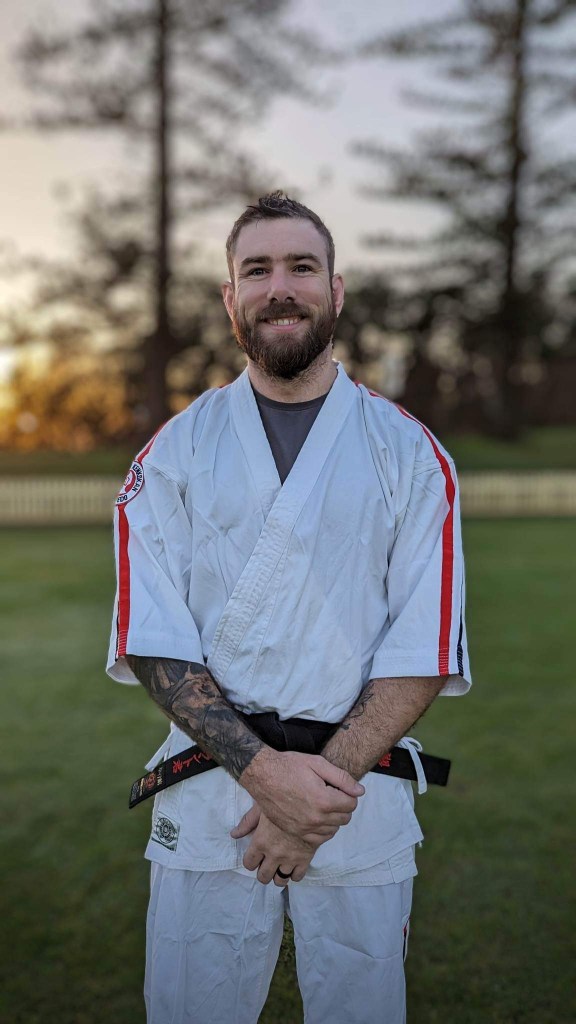
Grant Brechney has studied in a variety of martial arts disciplines over more than two decades with a prolific competition history.He holds gradings in Shorin jiryu Karate-do(3rd Dan), Arjuken Karate/MMA (2ndDan), Brazilian Jiu Jitsu (Brown Belt),Modern Arnis of the Philippines (BrownBelt) and regularly practices, Muay Thai,boxing, and wrestling.
Grant competed in hundreds of full-contact Karate competitions winning two world championships in Koshiki Karate at heavyweight and competed internationally on several occasions in Australia, Malaysia,and Canada. He won two amateur MMA titles and competed at the professional level in MMA in Australia. He won a Brazilian Jiu Jitsu world championship as a blue belt and has competed in over one-hundred other Brazilian Jiu Jitsu bouts.
Grant is a PhD candidate in his 5th year at Charles Sturt University in NSW. He is a published Exercise Scientist with a research focus on investigating the performance effects of weight cutting on combat sport athletes. He is the owner and head instructor of Karate, Brazilian Jitsu, and MMA at Ascend Martial Arts in Tweed Heads, NSW.
Instagram
https://www.instagram.com/thestorm.mma/
Facebook
https://www.facebook.co/TheStormMMA
Email –
thestormma@gmail.com
Website –
http://www.ascendmartialarts.com.au

 Martial Arts Magazine Australia
Leave a comment