
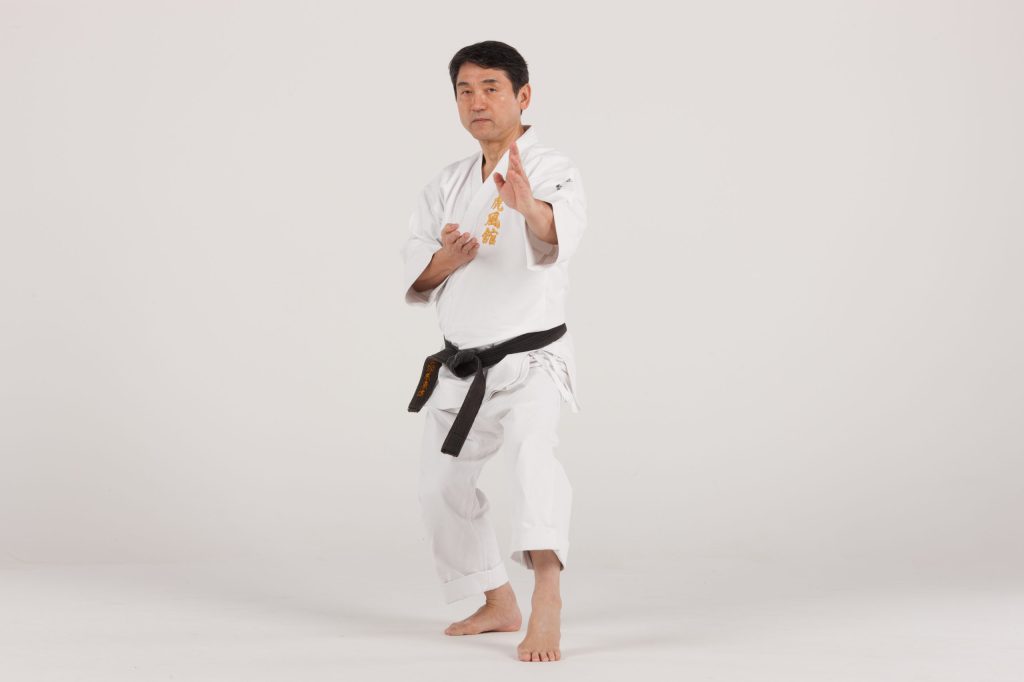
Shihan Tomiyama, returned to Western Australia in April 2023, to teach seminars throughout Kofukan Australia’s metropolitan dojos for the first time since the pandemic.
Shihan Tomiyama is senior instructor of Shito-Ryu Karate-Do Kofukan. Shihan Tomiyama is also the Chief Instructor of Kofukan England and in 2022 he was awarded the rank of 9th Dan by the English Karate Federation and declared a living legend amongst karateka.
While in WA, Sensei Brian Chambers sat down to chat with Shihan Tomiyama.
Brian Chambers: What have you enjoyed about karate?
Shihan Tomiyama: My main purpose for Karate is to become better, to get to a higher level. The pursuit of getting to a higher level is my number one pleasure. Meeting people, our members are nice people, spending time together – training, eating, talking. That is my pleasure, yes.
Brian Chambers: We changed from Tani-ha Shito-ryu to Kofukan Shito-ryu. How did that eventuate and what is the difference between the two?
Shihan Tomiyama: Technically, there is no change at all. We have been Kofukan all the time with myself and Shihan Omi as leaders since 1981. (Shihan Yasuhiro Suzuki was the leader before that.) Both of us are students of Master Chojiro Tani, founder of Tani-ha Shito-ryu, so was Sensei Okubo. So the Kofukan organization was affiliated with the Tani-ha Shito-ryu Shukokai organisation naturally. When Master Tani died, we naturally remained within Tani-ha Shito-ryu Shukokai with Master Tani’s son Hiroshi Tani as the new leader (Soke).
As time went by, it became apparent that the new Soke and we have different ideas. So, in 2017, considering that we had been supporting the new Soke for 20 years and in doing so had repaid our debt of 30 years being students to his father, we decided to withdraw from the Tani-ha Shito-ryu Shukokai organization
Brian Chambers: This is the 50th year anniversary 2022, year of the tiger. How has that been celebrated throughout the organisation?
Shihan Tomiyama: Shihan Omi and I came to Europe in 1972 and our most senior members have been supporting us since around that time. So, in 2022, we awarded them with new Dan grades and titles.But as we were in lock down due to COVID, we were unable to physically do anything to celebrate. Everything started moving again from this year.
Brian Chambers: How has the Kofukan organisation progressed or grown over the last fifteen years?
Shihan Tomiyama: I decided to promote our Karate outside our existing countries in 1991 because I thought our Karate was unique and different from many other schools and I had better let the world see what we were doing. So I started travelling to new parts of the world.
We had just eight member countries in Europe then. I travelled to Oceania, India, Middle East, Southern Africa, North and South America and Eastern Europe. After some years, Kofukan had spread to more than 25 countries.
For the last ten to fifteen years, I did not try to expand the organization because I wanted both to achieve a higher level myself and to help our members to get to a higher level. I wanted to improve the quality inside the Association. I considered that our expansion period was probably over and that I might not have enough time to teach our Karate to a sufficient level in new countries, especially now as I get older.
Brian Chambers: Looking back on your career– what are your greatest moments, most memorable moments, and what would you have done differently?
Shihan Tomiyama: The most memorable moment of my Karate life was when I trained with Master Fujimoto for the first time. I always wanted to become better but, when I became an International Referee and travelled around Europe with the English National Team, I realized that Sport Karate was not what I was looking for. When I visited my university karate club in 1980, I met Masters Yamashita and Uehara, also graduates of the university. They were teaching what they had learnt from Master Kenwa Mabuni, founder of Shito-ryu. I thought it was probably the Karate I was looking for.
I went back to Japan in 1982 and stayed therefor three years due to my father’s illness. At that time, Master Yamashita persuaded Master Fujimoto, who had been refusing to teach, to start teaching. At the first training session with Master Fujimoto, I was totally convinced that it was the Karate I had been looking for. We only live once, and I found what I was looking for. I feel very lucky.
Brian Chambers: In the past you have been doing some seminars with Wado-ryu instructors in the UK. What is your relationship with the Wado-ryu clubs, and do you have a ranking with Wado-ryu?
Shihan Tomiyama: Sensei Shiomitsu, a Wado-ryu instructor, proposed to all Japanese instructors who were resident in the UK (except seniors like Masters Enoeda and Tatsuo Suzuki) and Ireland to get together and exchange ideas to better ourselves in the1980s. Initially, one Shotokan, one Shito(myself) and five Wado instructors got together and held one training course. Since then, we had two training sessions as well as one course per year. After the first course, the Shotokan instructor pulled out of the group so it became a Wado and Shito course. A Wado instructor teaches Wado and I teach Shito. I do not practise the Wado style and do not have any ranking with Wado.
Brian Chambers: I have seen the applications of your karate to be like building blocks that form levels, with each level adding to become more complex fighting levels or systems. We have seen you do Uechi style kata is the way that you perform these kata a planned progression of your Shito-ryu style – another level of your fighting system as opposed to just performing another Uechi-ryu kata or a kata from another style. Have you put your personal style and applications into this Uechi kata or is this the original kata from those that taught it?
Shihan Tomiyama: These Katas are what I learned from Master Fujimoto.As I mentioned earlier, these are the Karate I was looking for. I learnt Doshisha Goju-ryu (Naha-te from Master Kenwa Mabuni) from Masters Yamashita and Uehara and these Katas (Master Fujimoto named his style En-ryu) are the backbone of my Karate.
Katas we practise within Kofukan are Tani-ha Shito-ryu Katas. I learnt from Master Tani but technical and fighting principles are from Masters Fujimoto, Yamashita and Uehara.
If my Karate is different from other Shito-ryu people, this is the reason. Also, if you see Uechi Katas performed by mainstream Uechi people, they are different from how I do them.
Master Fujimoto learnt these Katas from Master Seijiro Sakihama, founder of Jugo-Shizen-ryu, who had learnt from Master Kanbun Uechi, founder of Uechi-ryu.
Brian Chambers: The technical principal of using the whole body in many of your applications, including Kobudo, is there some similarities with the Japanese arts of kendo and sumo with the way you use whole body in karate?
Shihan Tomiyama: Like Karate, there are two kinds of Kendo, modern (sports) Kendo and old (traditional) Kendo (Kenjutsu). Old Kendo has lots of similarity to my Karate using the old Martial Arts principles of Japan. Master Fujimoto practiced Kendo from a young age before starting Karate. He used principles of Miyamoto Musashi to explain his Karate.
Jodo, which I have practised for the last 30 years or so, is one of the traditional Japanese Martial Arts and I have learnt quite a lot from it. I do not think Sumo has much in common with Karate, although I enjoy watching it.
Brian Chambers: During the COVID outbreak how did you use your time –traditional karate practise, study,developing drills, trumpet practise?
Shihan Tomiyama: I slept more, started watching YouTube, wrote Kata booklets etc. Karate wise, it was not much different although I did not teach. And, yes, I played trumpet.
Brian Chambers: Can we expect to see you publish any more books or educational videos?
Shihan Tomiyama: Maybe. Hopefully,something new can be produced.
Brian Chambers: The pin’an bunkai kumite you developed is lethal. Can we expect to see more of this kind of drills for other katas?
Shihan Tomiyama: Again, maybe. Those senior people who train with me regularly have learnt my ideas.
Brian Chambers: Have you thought about designing your own kata?
Shihan Tomiyama: No. There are already enough Katas.
Brian Chambers:
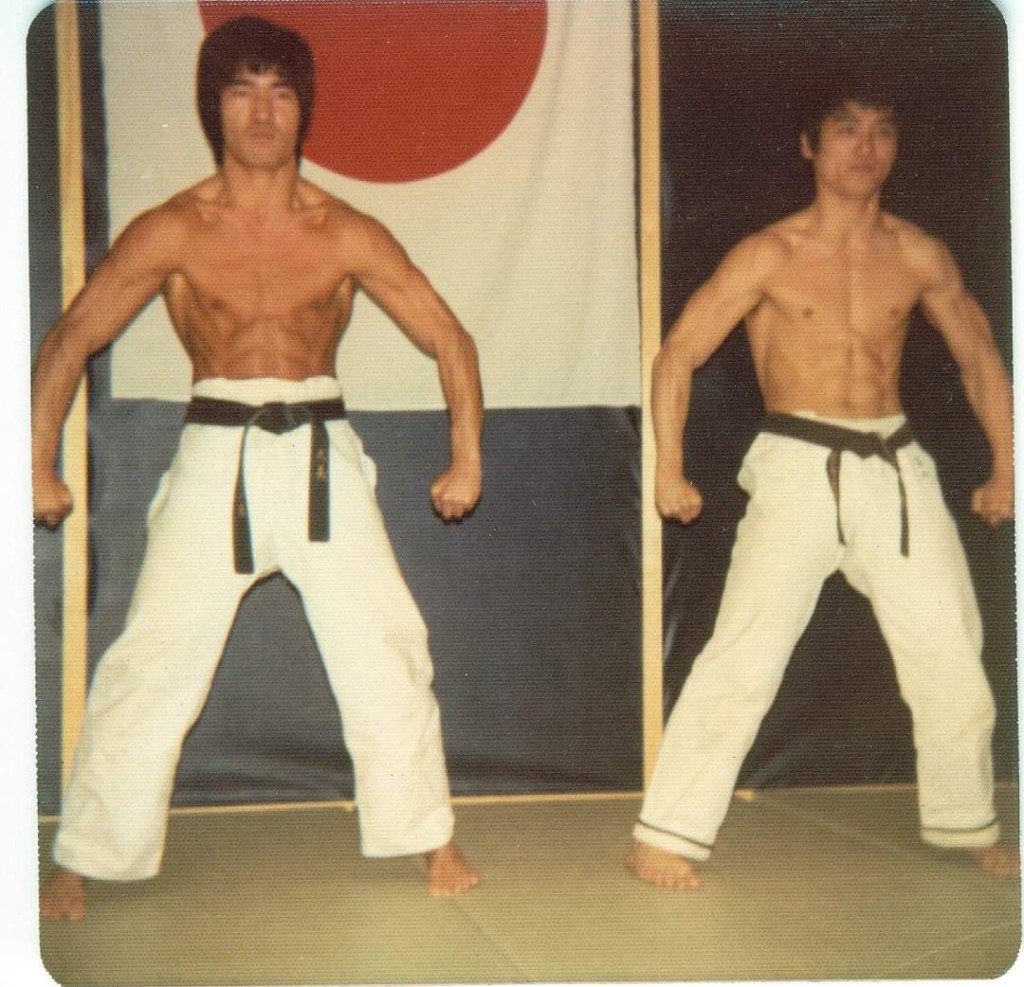
There is a photo of you and Sensei Omi with no gi jacket and big muscles – how did you get those muscles?
Shihan Tomiyama: At university, we trained very hard. Training lasted three hours. Roughly speaking, one-hour physical training, one hour basics and one hour fighting. Every day, we did a minimum of 500 sit-ups. At training camps, we had three sessions a day, and we did 1000 sit-ups in each session.Once, we did 2500 sit-ups continuously. We did a lot of physical training. At that time, there was no control in chudan punches and kicks, so we had to be strong. Shihan Omi and I continued in the same way during our early days in Europe and our senior members remember that well.
Brian Chambers: What other exercises did you used to do during training?
Shihan Tomiyama: Exercises were fairly simple. Press-ups, sit-ups and squats. Only the numbers were big, several hundreds to a thousand. Also, we did lots of basics. A thousand punches, hundreds of kicks, basic stances up and down the dojo many times. Once in a training camp, we did two hours of Shiko-dachi, non-stop. Hard training develops will power.
Brian Chambers: Is there any legacy or message to the world about your karate that you are leaving behind?
Shihan Tomiyama: Originally, I had an idea(or desire) to make several books to coverall Tani-ha Shito-ryu Katas. But, making books is a very big task and I do not think I will manage to complete the task. So, I wrote a description of all Tani-ha Shito-ryu Katas in English and distributed those to our senior people in five PDF booklets. The orders of Katas are one thing, but I hope our higher graded people have learnt my principles of Karate which I have accumulated over the years.
Brian Chambers: Have you considered writing an autobiography?
Shihan Tomiyama: No.
Brian Chambers: What would be your advice to people that are practicing karate or want to practise karate to become successful in performing karate?
Shihan Tomiyama: Learn and practise proper basics and basic katas which teach our principles. Once you understand the principles, it is much easier to develop yourself.
Brian Chambers: The change over from Tani-ha to Kofukan Shito-ryu the announcement was at the eightieth anniversary of Doshisha University. Your relationship with karate is essential through Doshisha University, and you haven’t been to Doshisha training since COVID.
Shihan Tomiyama: Doshisha University Karate Club is the home of our Karate. It was established in 1937 with Chojun Miyagi, founder of Goju-ryu, as its Technical Director. Then it was handed over to Kenwa Mabuni, founder of Shito-ryu. Masters Tani, Fujimoto, Yamashita and Uehara are all graduates of the club. So are Shihan Omi and I. COVID stopped everything all over the world. But I have been to Doshisha this year. So things are getting back to normal gradually.
For more information about Kofukan Karate Australia and upcoming seminars with Shihan Tomiyama: https://kofukankarateaustralia.com/
International events
https://www.kofukankarate.com
Sensei Brian Chambers runs Kofukan Karate Kalgoorlie and he can be contacted at: kofukankalgoorlie@gmail.com

 Martial Arts Magazine Australia
Leave a comment