by Duncan Mitchell
I had a stroke in July 2016, which left me, completely paralysed down my left side and with a left side vision loss. After years of playing competitive sport, I was now a paraplegic.
I had played squash to a decent level and golf to a 12 handicap. I suddenly found myself unable to play any sports but I could walk and my arm movement was coming back, so I needed something to drive me and focus on. I’d always wanted to try a martial art, but I never had the time with three kids, work and other pursuits, until I found myself divorced, unemployed, living on my own.
I saw an advert to come and try Aikido, I was aware of Aikido through movies, etc. but didn’t know anyone who practiced it. I had friends who did BJJ, kickboxing and taekwondo. My eldest son, who was 21 was starting boxing, but I didn’t really think I was capable of these. I went along to West Coast Aikido in Wangara to chat with Sensei Ross Taylor to explain my health issues and see if I could try. I received a very warm welcome and once on the mats I found I could get along quite well. The instructors were aware of my limitations and cut me some slack while still making sure I put in the effort to the best of my abilities. I still have some left knee issues, so I have some problems rolling, but apart from that, I can manage most techniques pretty well.
I found the grading system and curriculum gave me a structure and progression which motivated me and getting my first tip on my white belt was a big milestone which spurred me on.
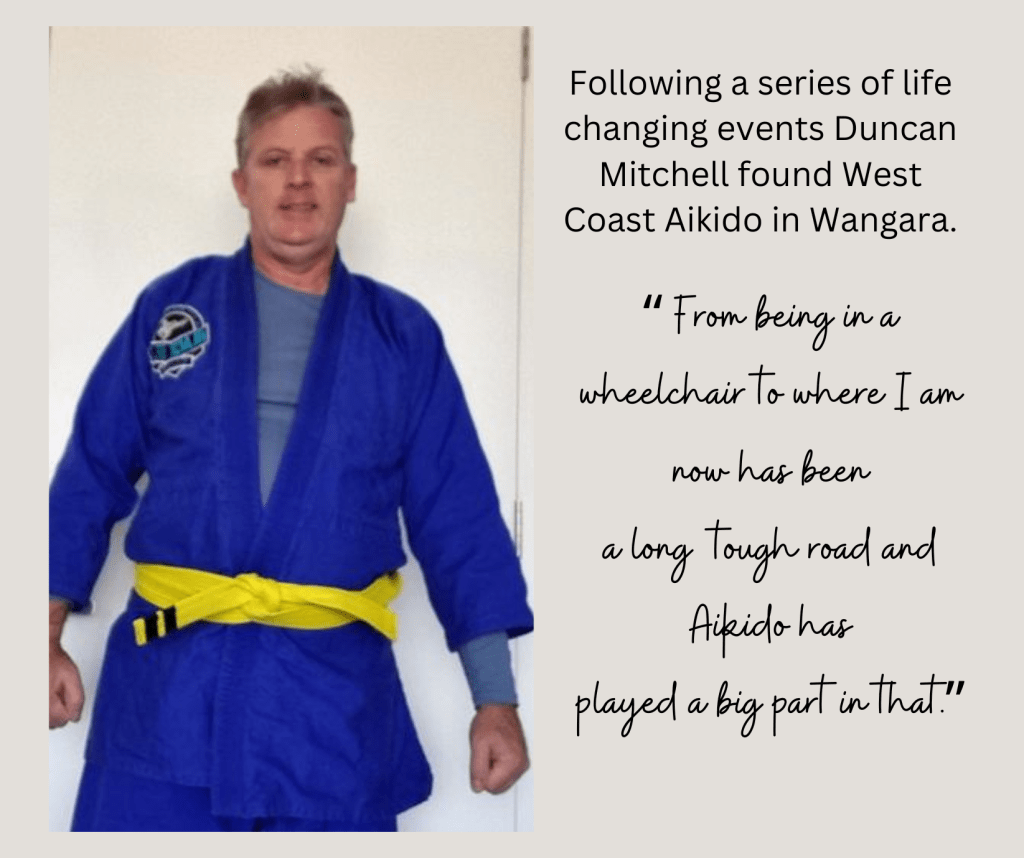
I’ve been training twice a week for a couple of years now and recently graduated to yellow belt, still a beginner, but my confidence has grown so much.
From being in a wheelchair to where I am now has been a long and tough road and Aikido has played a big part in that, not only from a physical aspect but the physiology and principles have played an important role in my mental health. The help and mentoring I’ve received from all the senior belts and instructors has been amazing. Although Aikido is often judged harshly by some, I think the fundamental principles and techniques are very powerful and I love it. I think more people should try it.
Top Tips
- Give it a try, you’ll never know how capable you are until you try.
- Talk to the instructors about any injuries or limitations you have.
- Find a Dojo you like, ask about a trial membership. When you commit to a training/attendance program stick to it.
- Try the techniques and modify to what works for you, a slightly modified technique can still have the same outcome.
- Work within your limits, the more you do the wider your limits will become.
- Practice at home, there is lots of content online these days.
- Study techniques of senior belts, don’t be afraid to ask, the only stupid question is the one not asked.
- When you are confident enough, share your knowledge with lower ranked belts.

 Martial Arts Magazine Australia
Leave a comment