by Mike Clarke
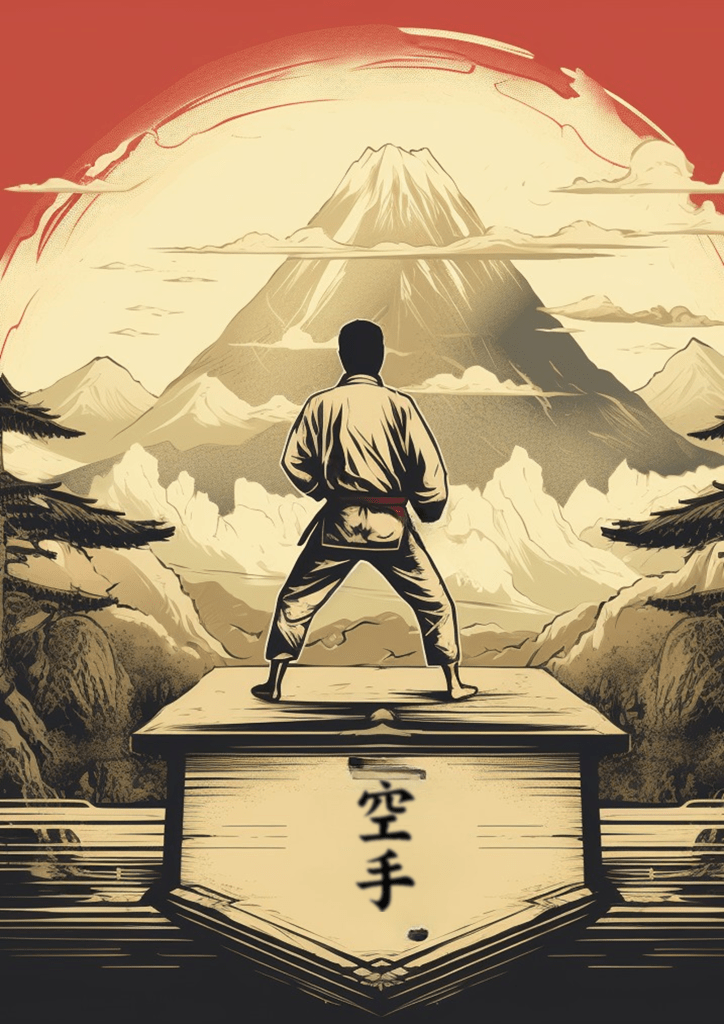
“True karate is this: that in daily life one’s mind and body be trained in the spirit of humility; and that in critical times one be devoted utterly to the cause of justice.” Funakoshi Gichin
In the words of the man all Shotokan karateka, regardless of affiliation, look to as their founding father (their model), there is no mention of ‘true’ karate being competitive. Nor do his words point to the need to be better than anyone else. His words offer advice to the individual, because karate can only exist in the heart and mind of the individual. Irrespective of how large the group, or how legendary the leader, karate itself remains unconstrained by group ego and tribal thinking. Regardless of the cognitive duality some are happy to accommodate, you simply can’t have ‘alternative’ truths. Why? Because a variety of truths lead to friction, turmoil, and eventually to hell. Here is a basic truth that’s conveniently ignored by many Shotokan karateka, Funakoshi Gichin sensei, an Okinawan, never practiced or taught Japanese Shotokan. His karate was Okinawan Shorin-ryu.
In the goldfish bowl that most karateka live out their existence, it is easy to accept the all- knowing knowledge of their leader and seniors. Yet, it takes very little to dispel the illusion. The justice Funakoshi sensei spoke of relies on ‘real’ truth, not the ‘alternative’ kind proving so popular these days. For many karateka, the stories they learn growing up are remarkably similar. Often, only the names and locations change, the result of a good story’s common appeal. In one group, the legendary figure fought a bull, in another, he defeats a notorious boxer. The details change, but the myth remains the same, told and retold to underscore in the initiate’s mind just how ‘righteous’ the group is. And so, the blurring of truth and myth begins.
Looking back to justify the present is an exercise fraught with danger, yet it is a very common practice. Religions do it, politicians do it, and karate people do it too. It is an exercise where facts don’t really matter, and the truth is marginalised in favour of a convenient view of things based solely on the current agenda of the group. With karate, it is not always possible to know ‘now’ exactly what occurred back ‘then’. Sometimes, it is impossible to even pinpoint when ‘then’ was. Karate’s true value however has always been found in ‘now’. Right now, is yesterday’s future. Right now, is tomorrow’s past; there has only ever been ‘right now’. With thirty- three years’ experience interviewing karate ‘leaders’ from around the planet, and fifty- years of training behind me, I believe I can speak a little to the common threads that run through today’s karate world. You may not be aware such strands exist. In fact, I can guarantee you know nothing of them unless you’ve spent a reasonable amount of time outside your own particular goldfish bowl. For a significant number of readers, your first glimpse of the familiar outside of your group may come as a shock. If that’s the case, I hope it’s a shock you’ll never recover from.
The foundation story
Every group, style, and association teaching a Japanese martial art today has its own foundation story. Each of them contains a kernel of truth, but that’s usually as far as it goes. The story’s role is not to provide the truth, its role is to create an impression in the initiate’s mind.
An impression that sets you and your tribe apart from others. Soon after joining the group, and almost invisibly, your sense of ‘self’ slips away unnoticed. No longer seeing yourself for who you are and what you stand for, you begin to validate yourself more by who you are not. You are not like those idiots in that other group/style/martial art, you don’t do things like them, you don’t do your kata that way, your group doesn’t give grades away, the list is endless. When thoughts like these enter your mind, the seed of group thinking sown on day one has germinated, producing yet another crop of compliant individuals ready for harvest. And let’s be clear, the turnover of students is so large in the world of commercial karate these days, a new harvest is needed every few months just to keep the teacher employed. Hence the fertiliser thrown around by those who would farm your desire to learn karate for their own financial/egotistical interest. First lesson free, regular gradings, family friendly fun, and perhaps the biggest single piece of bull sh*t to be offered to the initiate: recognition.
It may surprise some of you reading this, but not all, that karate is not and never has been held in high regard in Japan. It’s standing within the pantheon of traditional martial arts is low. Hardly surprising when you consider karate’s shambolic beginnings in that country just a century ago, and later, the squalid arguments over succession that erupt with depressing regularity following the death of a significant leader. You may be familiar with the lengthy legal battle fought by rival factions within the JKA some years ago, but that event was not unique. The same thing happened within the Kyokushinkai following the death of its founder, Mas Oyama. Shito-ryu, Wado- ryu, and Goju-ryu too, have all witnessed a similar process. Budo principles being swept away by greed and avarice, how very uninspiring.
I have long been unsure why any self-respecting karateka outside of Japan feels a need to be recognised by karateka who happen to live there. Alfa-males, and other inadequate personalities to one side, I wonder how a very small number of Japanese karateka knowing your name is going to make any difference at all to who ‘you’ are?
The path well-travelled
There are two main streams of thought prevalent in karate these days. The first looks to Japan/Okinawa for leadership and guidance. The second doesn’t. Ironically, it hardly matters which side of the divide you stand, as very few groups passing on karate today have abandoned the ‘Seven steps of learning’ so long ingrained in Japanese culture. You may not have heard of these ‘steps’ before now, but I can guarantee your education in karate has been influenced by them. And though I’m not a gambling man, I’m willing to bet a great many of you reading of them here for the first time will find them entirely familiar.
Copying the model
Gaining mastery of the ‘model’s’ technique is paramount. This is done by rigorous instruction followed by ‘stealing’ techniques via observation and solo practice. Interpretation is strongly discouraged, and creativity is allowed only after a great many years of study.
Discipline
Teachers will stress the necessity of severity to their students. And bring to bear various levels of physical and psychological hardships that must be endured by the student in order to promote in them a sense of personal growth. Above all else, students are encouraged to be loyal and persevere
The Master – Student Relationship
The roles of sensei and deshi (teacher and student) are clearly defined, becoming a line that must not be crossed. For both parties an image of the founder, the ideal practitioner of their art, exists in their imagination and is considered by both the teacher and student to be ‘the model’.
Secrets, stages and the hierarchy of study
Teachers impart the techniques of the art in hierarchical stages marked by the granting of certificates, ranks, and titles. Progress in the art takes place by memorising an increased repertoire of movements. In many cases, ‘advanced’ techniques require no more skill to execute than those taught to a beginner. The ‘advanced’ student being someone who has simply had more time to practice what to do.
Established lineages
In Japan, various organisations and their affiliates exist for every school dedicated to a particular art. Their legitimacy was often established on nothing more than a tenuous link back to the founder. Despite immeasurable physical and moral differences evolving over time, groups, for the sake of authenticity, hold fast to the notion of being linked to a founder (the model).
Non-verbal communication
Teachers often stress non-verbal forms of communication by insisting students simply follow (imitate) the model provided to them by their teacher (example). What oral communication there is often comes in the form of jargon, metaphors, and parables…and sometimes, downright lies.
The art as a spiritual quest
The study of the art is positioned as a gateway to a higher level of spiritual understanding. The ultimate goal no longer mastery of the physical techniques and how to use them, but instead, mastery of the ‘self’. Questioning the inconsistencies often observed by students between the teachings of the ‘model’ (founder) and the ‘example’ (teacher) standing in front of them is strongly discouraged.
To the Japanese way of thinking then, the ‘way’ of karate appears to be no more special a path through life than the ‘way’ of any other artistic pursuit. Here’s something to think about…what you draw from your experience studying karate depends entirely on what you bring with you when you begin, and what you do when you encounter problems along the way. As far as I’m aware, change is the only constant in the universe. You might say, “What about energy?” Well, you’re right. But consider for a moment that without the ability to change form, energy too would stop. With this example, I wonder sometimes if nature isn’t whispering to us that change, rather than a corrupted notion of tradition is, if considered, a fundamental necessity to experiencing not only growth but a balanced way of life. The longer you live and the longer you practice karate, the more important it becomes to understand the lesson here. Stick to what you’ve always done, and you’ll always be what you always were: stuck! Therefore, traditional karateka have to ask themselves… ‘What exactly is the tradition I’m claiming to propagate?’
Making gods of men
It is not uncommon to come across this phenomenon in the karate world, especially if the ‘god’ in question is no longer alive. And even when they are still breathing, a great many karateka place their teachers on pedestals so high it’s a wonder they don’t suffer permanent nose bleeds. There is a word for it, it’s called ‘Apotheosis’. I have met several ‘karate gods’ over the years. The best of them were sublimely human. But a few had serious, and obvious, phycological problems as a result of believing their own publicity. Not only is it unhealthy to ‘give’ yourself over to another person, it is also downright dangerous to your financial security and mental wellbeing. When you begin to see something ‘other worldly’ in another human being, it is time to take a long, hard look at yourself. The need for heroes has always been an easy path to exploitation, and nowhere more so than in the esoteric world of martial arts. And while it is often beneficial to your own growth to take inspiration from the growth in others, there is no need to lose perspective. You should never make gods of men. No one you’ll ever meet in a gi is anything other than a human being. Remember that the next time you suspend your ‘common- sense’. Remember, it too when the gap between what they say and what they do fails to reflect your own understanding of self-improvement.
Most of the (said to be 50 million plus) karateka in the world are not Japanese. Nor are they Okinawan. The overwhelming majority of people who identify as karateka today come from countries and cultures far removed from Yamoto*. Strange then, that an archaic and idiosyncratic Japanese way of learning continues to prevail.
Okinawan karate teachers have long ignored their Japanese neighbours when it comes to the ‘way’ of karate, but in doing so they have paid a heavy price. Ridiculed, bullied, and treated disgracefully by karate’s political elite in Japan. Okinawan sensei today live in a kind of karate no-man’s-land. And while it is true to say that many karate sensei on the island do their best to maintain their traditional ways, a great many have surrendered over time to the stick and carrot approach adopted by Japan. Tokyo’s begrudging acceptance that Okinawa, and not Japan, is the physical and spiritual home of karate, was paid for by denying Okinawa any role in the recent Olympic games where, as many of you know, a form of karate exhibitionism was introduced.
As well, the promised amount of funding to establish a purpose-built training facility on Okinawa to showcase karate and kobudo, the Karatedo Kaikan, never materialised. The complex of buildings seen today is barely half the size of the original concept planned for the Kaikan. Okinawa, once an island paradise with a vibrant and unique culture that gave birth to karate, continues to pay the price for the rigidity of Japanese thinking and their unambiguous self- righteousness. Screaming American jets that fly low overhead, and the constant landing and take-off of heavy military aircraft over built up areas, has made life for many Okinawans a living hell. The accidents, the crime, the rapes, and the refusal of the Japanese government to do anything other than appease their American allies, continues to reflect the true relationship between Japan and Okinawa as one of master and subordinate, parent and child.
The key characteristics of iemoto seido are no doubt recognisable to all karateka with more than a couple of years training behind them. The emphasis on the master-pupil relationship, the established hierarchical order within the ‘family/group’, the unquestioning authority of the head, the ‘iemoto/head of the house’. The underlying sense within the group of exclusivity as far as being authentic, traditional, and being right! Those who have made a detailed study of Japanese culture sometimes refer to iemoto seido as ‘closing the circle’ and think of it in terms of providing the model for how Japanese institutions, indeed Japanese society as a whole, conduct themselves. Schools, companies, political parties, even the yakuza*, in fact any group in Japan large or small, exhibit similar traits and conduct themselves in ways easily recognisable as stemming from the notion of iemoto seido.
But you shouldn’t be surprised to learn this, right? After all, Japanese karate is just another sub-culture, and was never likely to be organised in any other way before being introduced to the rest of the world. Their view of karate, unlike the art in its native Okinawa, was never going to allow for individualism, either in thought or movement. If you’re a nail determined to stand up, you will be hammered back down, because that’s the Japanese way. Offend the ‘family’ and suffer the consequences.
There is an aside to the iemoto seido system that like its physical counterpart, is easily recognisable to karateka today. Whereas iemoto seido is a structure, a skeleton if you like upon which an activity can be hung, the actual art, or skill (techniques), is known as ‘ieryu’ or ‘house style’. To the Japanese mind it is not enough to be good at the art you practise, or to have developed a deep understanding of it, you have to be ‘recognised’ by others. The greater the recognition, the greater your standing (sounds familiar, right?). Okay, so here is the truth of it. Back when the Tokugawa shogunate (ruling elite) were slipping away, it identified in certain artistic endeavours a means by which specific nobles might create a source of income for themselves. So, the shogunate assigned these families exclusive rights to receive payment for certifying the non-noble practitioners of various arts. This idea of ‘recognition’ remains a powerful selling point in many arts to this day, including karate. But in truth it is little more than a ‘arubaito’, a cash-in-hand side job that brings in extra income. In Japan today there are any number of ‘iemoto’ (head of the house) presiding over any number of ‘ryu’ (schools). From dance, acting, flower arranging, and even how to slice live fish before serving, there are iemoto ready and willing to ‘recognise’ you as a master of the art…for a price.
As you might expect given the human condition, money, and not skill, is often at the heart of keeping these ‘traditional’ ryu/schools alive. Thousands of dollars change hands each year between those wanting to be recognised, and those who by happy chance find themselves with the appropriate certificate and stamp to fulfill their need. Accordingly, an illusion of progress is established. However, inferior skills are often authenticated and individuals with suspect characters regularly gain promotion. And for both, outrageous fees are charged to move from one rank to the next. But it’s not only when people are ‘on the make’ that the iemoto seido system proves problematic in an educational sense. When an individual behaves contrary to the view or wishes of the iemoto, they are divorced from the entire group. Ostracised by everyone for fear of being punished in similar fashion. Group consciousness is required to maintain the iemoto’s control, the exclusiveness, and the sense of ‘us’ and ‘them’. Individuals who disturb the façade, and other groups within the same discipline are therefore viewed as rivals, to be considered as opponents and treated accordingly.
The karate found in Japan is in many ways little different from that found in other countries. More intense in many cases for sure, but still locked into a familiar rigidity of thought and appreciation for karate you can find anywhere around the world. Hardly surprising when you consider how hard various Japanese karate schools worked to spread their particular version of the art internationally. How much of karate’s teachings have been lost or replaced during its global migration from Japan is evident in today’s infantile attempt to resurrect ‘oyo’ under the confused banner of ‘bunkai’.
I shake my head watching their efforts… karateka with answers desperately searching for the right questions. You simply can’t orchestrate a fight, not a real one anyway. I have read the phrase, ‘principle before technique’ many times in various publications over the years and wondered why so few karateka have actually adopted the idea. Understanding iemoto seido is the closest I have come to an answer.
In recent times, it has become acceptable to adhere to ‘alternative’ truths by basing your opinions on ‘alternative’ facts. “Everyone’s entitled to their own opinion,” isn’t that the standard logic applied these days? While the latter might be true, it’s not the same thing as having the right to express your opinion. That particular ‘right’, as with all other rights, comes at a cost. The price for articulating your opinion is paid for, in advance, with experience. It’s a simple idea really, if you haven’t paid to acquire it then an opinion isn’t yours to express. And if that’s the case, then you might at least have the maturity and good manners to keep your opinion to yourself. According to the iemoto seido model, my thoughts on karate expressed in this article will be thrown away as quickly as possible. Not because they are unworthy of further consideration, but because I am an outsider as far as your particular group is concerned. How easy then, according to the education many of you have received so far, to dismiss everything you’ve just read and move on.
As Michelangelo wrote long, long, ago…. “The problem with man is not that he aims too high, and misses; but that he aims to low and hits.”
My thinking is this… the quest for all martial artists should be to prove him wrong.
Find more from Mike Clarke here: https://ymaa.com/publishing/author/michael-clarke
*Yamoto – The ancient name for Japan.
** Yakuza – Organized criminal gangs similar to the Italian Mafia.
References:
Transmitting tradition by the rules: Robert J Smith Seven characteristics of a traditional approach to learning: Gary De Coke

 Martial Arts Magazine Australia
Leave a comment