by Danni McCullough BSc, MPsych(Clin), Shodan WJJF Ju Jitsu & 1st Kyu Gyokushin Ryu Aikido & Lance Spice, Shodan Gyokushin Ryu Aikido

Mindfulness in motion or moving meditation are phrases that have been used in many academic papers to describe the Martial Art of Aikido. These phrases basically refer to the way the practitioner must calm or still their mind while their body is in motion to effectively deliver a technique.
Aikido is a relatively modern Martial Art and is considered by many as having varying effectiveness depending on the principals of the various branches. Aikido was developed by Morihei Ueshiba (1883-1969), who came to be known as O-Sensei, he had developed the art predominately from Daito ryu Aiki Jujutsu and was inspired by his studies in Zen and meditation at the Shingon School of Buddhism (Westbrook & Ratti, 2012).\
Gyokushin Ryu Aikido was developed by Terumi Washizu Sensei who was trained by Minoru Mochizuki Sensei the founder of Yoseinkan Aikido and an early student of O- Sensei. The key reason behind the development of Aikido was for the Nage (receiver of the attack) to effortlessly redirect the Uke’s (attacker) energy.
Our lineage of Aikido (Gyokunen Kan Aikido) was as a result of Washizu Sensei in 2022 presenting this name to Sensei Colin Niland based on his blending Aikido with other martial arts and Aikido styles in his Budo school. The name meaning Gyoku (ball like) Nen (Minoru Mochizuki’s first name) and Kan school.

In delivering our Aikido syllabus we talk to the five pillars of Gyuokushin Ryu Aikido:
- Tai Sabaki (movement)
- Teodoki (hand escapes)
- Atemi (striking)
- Ukemi (falling / rolling)
- Nigiri Gaeshi (return grasps)
While these are all equally important parts of what Aikido practitioners do, it is important to remember that the mind moves the body. “Mind moves body” in itself seems a simple concept on the surface, but the minute you start thinking about a technique to apply, you not only loose the mind / body relationship but also the Uke / Nage relationship. Both relationships require a blending or a linked fluidity. They are both symbiotic relationships that one without the other won’t deliver any level of effective outcome.
Martial arts practitioners from all forms and styles will learn choreographed techniques around a set of basic principles, eventually training regularly and consistently so that the techniques become muscle memory and almost second nature. In the early stages of training students are thinking about foot placement, movement, blocking, striking, grasps locks and throws. Often these thoughts are coupled with self-judgement and other internal dialogue. In addition, trying to remember all the various aspects of techniques can lead to a lack of movement and breathing and over thinking. This ultimately impacts the delivery of the technique and results in trying to muscle the technique or failing to take the ukes Kuzushi (taking the opponents balance). The Irony is that students at all levels can suffer similar failings when they feel pressure from demonstrating in front of other students or when defending attacks from senior belts.
It is within this space that Mindfulness and Aikido blend, with the practice of one set of principles working to help improve and enhance the other. Mindfulness is the practice of paying attention, on purpose, in the present moment and noticing one’s thoughts, feelings, physical experiences without judgement (Kabat-Zinn, 2003). It is often paired with meditative techniques, such as deep breathing, to assist with focus and calming the nervous system and controlling the body’s “fight or flight” response. In the everyday practice of mindfulness individuals report improved sleep, lower stress levels and physiological benefits such as lower blood pressure (Brand et al., 2012; Solano-Lopez, 2018). Studies have found that practitioners of martial arts when compared to non-practitioners have significantly higher levels of mindfulness and well-being, as well as improved psychological health (Kobayashi, M.H. et al. 2020).
An example of how Mindfulness and Aikido work together can be seen in the practice of Kihonwaza (basic techniques). Kihonwaza require us to execute basic body movements, such as Tai Sabaki and Naegiri Kaeshi, coordinating movement and timing with an Uke. This requires the student to adapt a state of Mushin (the mind is alert but empty of thoughts) and Musubi (the state of mental and physical connection between training partners). The student’s attention must be in the present and attuned with their internal experiences and external environment, creating the basic state of Mindfulness. Secondly, while conducting movement in repetitive and flowing motion, students are encouraged to breathe and activate their Ki (inner energy held at the centre of the body). This has the effect of lowering the heart rate, reducing cortisol levels and further grounding the student in the present, potentially deepening their meditative state.
The final and possibly most challenging element of Aikido and Mindfulness practice is the student learning to adapt a mindset of non-judgement. This task requires us to have the ability to acknowledge when our inner experience shifts from the present focus to unhelpful thoughts and feelings i.e., embarrassment or frustration at our performance. We then need to intentionally, without negative judgement, move our mind back to the present – in this case, our breathing and movement.
The benefits of this practice are exponential, influencing everything from our ability to improve technical expertise to learning how to manage our emotions and the challenges that we all face in daily life.
As research continues into the physical and psychological benefits of modern Mindfulness and Aikido practice, it’s important to look back and remember the words of Morihei Ueshiba – “Master the divine techniques of the Art of Peace and no enemy will dare to challenge you”. It is with the promise of finding the balance of calm and fortitude that O-Sensei invites us to step onto the mats and discover for ourselves the path of the Budo.
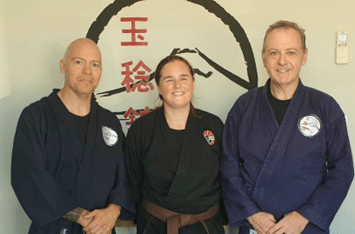
Gyokunen Kan Aikido www.ommabudo.com,
Sensei Colin Niland, Sandan Gyokushin Ryu Aikido Phone: 0405946661
References
Brand, S., Holsboer-Trachsler, E., Naranjo, J. R., & Schmidt, S. (2012). Influence of mindfulness practice on cortisol and sleep in long-term and short-term meditators. Neuropsychobiology, 65(3), 109-118.
Kabat-Zinn, J. (2003). Mindfulness-based stress reduction (MBSR). Constructivism in the Human Sciences, 8(2), 73.
Miyata, H., Kobayashi, D., Sonoda, A., Motoike, H., & Akatsuka, S. (2020). Mindfulness and psychological health in practitioners of Japanese martial arts: a cross-sectional study. BMC sports science, medicine and rehabilitation, 12, 1-10.
Solano Lopez, A. L. (2018). Effectiveness of the mindfulness‐based stress reduction program on blood pressure: a systematic review of literature. Worldviews on Evidence‐Based Nursing, 15(5), 344-352.
Westbrook, A., & Ratti, O. (2012). Aikido and the dynamic sphere: An illustrated introduction. Tuttle Publishing
.

 Martial Arts Magazine Australia
Leave a comment